

Encyclopedias of Everything
Lately I’ve been dipping into the great encyclopedias, and I’m pretty sure I’ll never be the same. Last week I revisited two old favorites, Aristotle’s History of Animals and Pliny the Elder’s Natural History. Yesterday I spent seven hours reading from Alexander von Humboldt’s magnum opus, Cosmos. By the end of the day, having plowed ahead to page 100 of the first volume and jumped around in a few chapters of the second, it was clear that the only suitable response was awed silence or a discussion so lengthy that it would rival Cosmos itself in length. I’ll take the coward’s path, for now, and maintain an awed silence.
Not completely silent, though, because I have to wonder: why is this work that was so influential to Darwin, Thoreau, and other 19th century thinkers so little known today? And, also: what in the world possessed Humboldt to think he could write it?
Like encyclopedic writers before him, Humboldt’s ambition was to produce nothing less than a detailed catalog of everything known about the physical universe in his time (he was born in 1769 and died in 1859). He had “the crazy idea,” as he wrote in a letter in 1834, “to represent in one work the entire material universe, everything we know today of the phenomena in the celestial spaces and of life on earth, from the stars in the nebulae to the geography of mosses and gigantic rocks, in a vivid language that will stimulate the imagination.” Unlike most of his predecessors, however, Humboldt did not include hearsay, superstition, folklore, or other information that could not be supported with objective evidence. His scientific integrity made the task more daunting, for he could not report what others had written without first investigating their veracity. To add to the difficulty, he was determined to find unity in nature’s complexity, or, as he wrote in the introduction to the first volume, “the Common and Intimately-connected in all terrestrial phenomena.” No wonder many scholars consider Humboldt a precursor to the modern science of ecology.
The result was four large volumes published at intervals from 1845 to 1858 (a fragment of a fifth was published after his death). To present some idea of the scope of the project, here is a portion of the contents included in Volume 1, which he called “the domain of objects” in the universe:
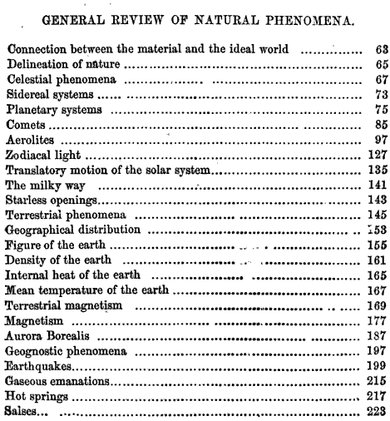
Table of Contents, Volume 2
Volume 2 represents the “domain of sensations,” and includes detailed discussions of how nature was described by writers from the time of the Ancients to Goethe; a history of landscape painting; a guide to the cultivation of tropical plants and an analysis of Western and Eastern traditions of landscape gardening; events in human history that influenced our views of the universe; astronomical discoveries made possible by the invention of the telescope; and a general survey of advancements in various sciences.
The three remaining volumes are, according to Wikipedia, elaborations on the subjects introduced in the first two volumes. I’ve been unable to find downloadable editions on Google Books or Project Gutenberg, and the few hard copies available are beyond my budget, so I have to take Wikipedia’s word for it.
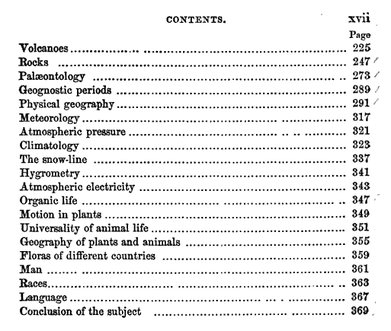
Table of Contents, Volume 2 (con’t)
Speaking of Wikipedia… Everybody probably already knows this or could guess it, but this vast online compendium is now officially the greatest encyclopedia the world has ever known. With 3,597,344 articles published (as of today, March 29, 2011) and more than one billion words, it easily surpasses the old record-holder, the Yongle Encyclopedia of ancient China, which is estimated to have contained up to 770 million words. Commissioned by the emperor Yongle in 1403 and finished in 1408, it was the work of 2,000 scholars who compiled 8,000 texts covering everything written up to that time in China about history, philosophy, religion, technology, agriculture, astronomy, geology, medicine, drama, and art. Only two copies were made, and only a few fragments have survived.
My reading is downright wimpy compared to yours, Jerry. I was up in the middle of the night reading Van Loon’s HISTORY OF MANKIND, a world history written for children. It was (I say in my own defense) the world’s first Newbery winner and soon became a hit with adults, too, going on to be published in paperback form for the grownups without all the wonderful little drawings and maps we young folks love.
I hope you will write a bit about Aristotle soon. Any chance?
HISTORY OF MANKIND wimpy? Sounds wonderful to me. Wish I had more to say about Aristotle, but alas, I’ve read with care only his natural science works and just poked around in some of the rest. I know barely enough to be dangerous — but enough to feel a stronger affinity for him than his teacher. At the risk of making a fool of myself I plan to shoehorn in a paragraph or two in an upcoming post. If I commit terrible gaffes, please tell me, but gently, gently!
There is something to be said about one person writing an encyclopedia rather than many others. I find that people compartmentalize areas rather than look at the system of things. Enjoy your reading. For your sake, maybe the warm weather should hold off a bit so you can get more reading done.
You raise a good point, Mary. Anything written by committee gets washed of personality. For reading pleasure, I’ll always take the rough and raggedy creations of single minds. Which makes me think of the colorful idiosyncrasies of the Britannica 11th edition, published in 1911. The articles in that edition were written by prominent writers and scholars who were encouraged to let their passions show. Lots of fascinating stuff. Also, unfortunately, blatant racism and other ugly relics of the age.
I can see how it happens. I started out wanting to know about one raggedy old flag and now the house is full of scraps of the Encyclopedia of Antrim, 1865-1920. Or something like that.
You have to respect Humboldt’s determination to research and then verify. I love Wikipedia, but it would be a whole lot less voluminous–though perhaps the greater for it–if the contributors followed his example.
I’m not telling anybody what I’m reading this week. Wimpy doesn’t begin to cover it.
I’m sure you’re right about Wikipedia, Gerry. I can’t get over the fact that it succeeds as well as it does. There are errors and repetitions, but, dang, mostly it works.
Hey! Only a few more weeks of underwear weather!
Great blog, enjoyed browsing through the site